
Haircare Bottle Decoration Mistakes That Surface After Filling
Most decoration mistakes on a haircare pack are invisible on the day the sample is approved. They appear weeks later, when the label edge lifts in a steamy shower, when a foil accent dulls in transit, or when a market rejects a pack because the sleeve interferes with recycling. The common thread is that the decoration was validated on a dry object in an office instead of on a filled unit in the conditions it will actually meet.
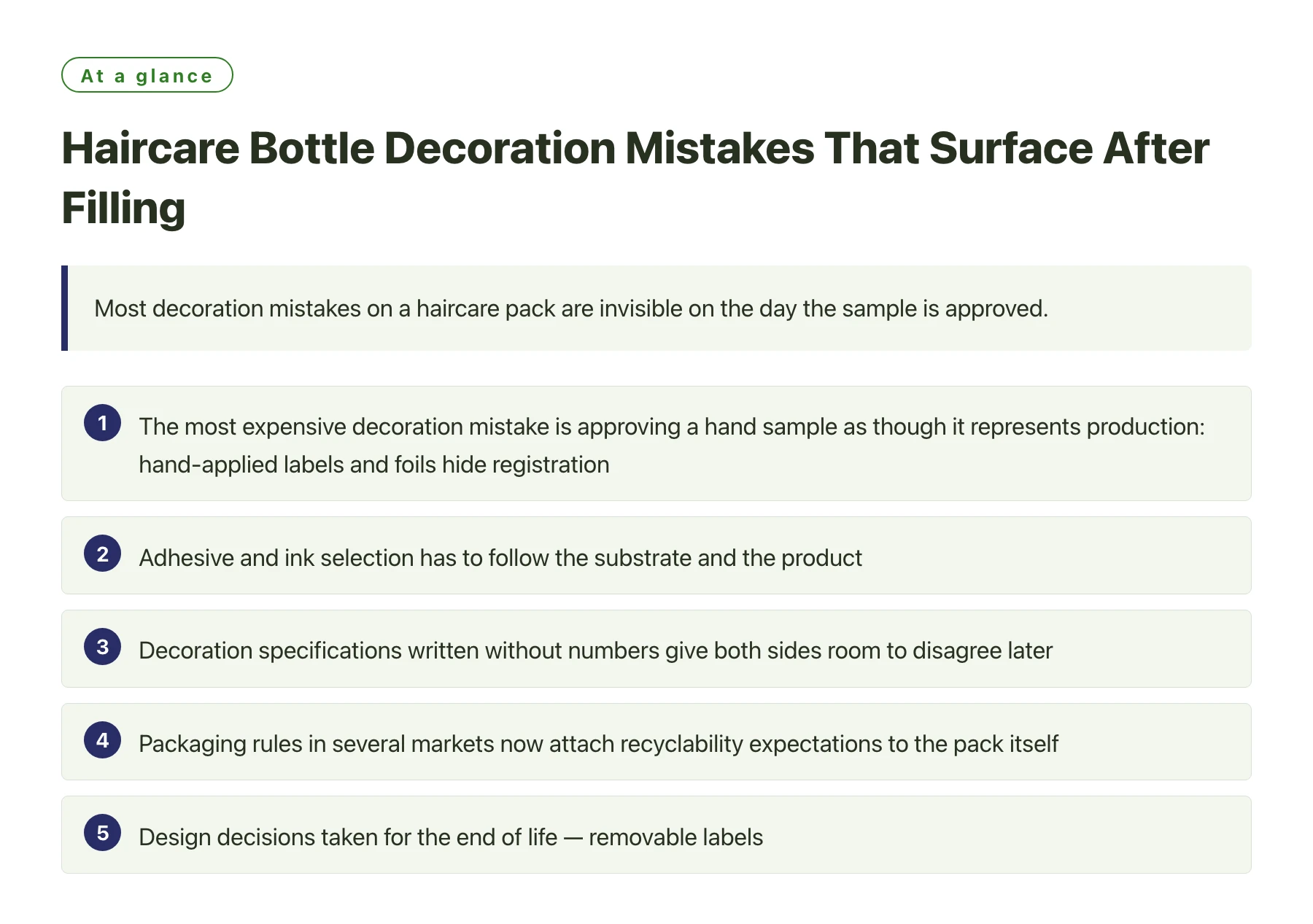
Key takeawaysThe most expensive decoration mistake is approving a hand sample as though it represents production: hand-applied labels and foils hide registration, coverage and adhesion problems that appear at speed. · Adhesive and ink selection has to follow the substrate and the product, not the other way round, because a system chosen for glass will not necessarily hold on a high-density polyethylene shampoo bottle. · Decoration specifications written without numbers give both sides room to disagree later, so coverage, position tolerance and colour reference belong in the document before the run. · Packaging rules in several markets now attach recyclability expectations to the pack itself, which turns a full-body sleeve or a metallised label from an aesthetic choice into a compliance question [1]. · Design decisions taken for the end of life — removable labels, mono-material packs, separated components — are the cheapest way to avoid a redesign once market requirements tighten [3].
Decoration sits in an awkward place in the production chain. It happens after the container is made and usually before filling, which means a defect can be introduced by a supplier who never sees the finished product and discovered by a party who did not commission the decoration.
That gap explains why the same handful of failures recur across haircare lines: nobody in the chain owned the specification end to end. This piece lists the mistakes buyers report most often, in the order they tend to appear, and pairs each one with the check that would have caught it earlier.
It is written from the quality side rather than the design side, because by the time a decoration defect reaches a customer, design is no longer the useful frame.
Mistakes that look like bad luck
The first is validating on a dry sample. A hand-decorated unit produced for approval will usually look excellent, because it was made slowly and inspected individually. Production output is made at line speed and inspected by sampling, so the questions to ask are about registration tolerance, coverage at the edges and how many units are checked per batch.
The second is choosing the decoration before the substrate. Teams often select screen printing or hot stamping because it suits the brand look, then discover that the chosen resin needs pre-treatment to hold the ink. The order should be reversed: material and product first, then the compatible methods, then the design within those constraints.
The third is treating the shower as a display case. Heat, steam, wet hands and repeated contact with surfactant products will find weaknesses that a room-temperature rub test does not. Durability testing has to reproduce the environment, not approximate it.
A fourth mistake is assuming that one party owns the whole pack. Decoration is often split between a container supplier, a decorator and a filler, and the specification is the only thing holding them together. Before committing, ask each candidate which parts of the pack it produces, decorates and fills in-house, and compare the answer against your own list. The combination of work described on the official site is one reference point for that comparison; what matters is that the boundaries are known before a batch fails at one of them.
The specification gap that causes most disputes
Ask three people what a good decoration looks like and you will get three answers unless the specification contains numbers. Coverage as a percentage or a defined area, position tolerance in millimetres, a colour reference the printer can measure against, and a classification for defects — these are the terms that turn a subjective judgement into an inspection.
It is worth drafting the inspection sheet at the same time as the artwork. If the sheet cannot be written, the specification is not finished. Industry coverage of packaging and quality practice makes a similar argument from the manufacturing side: decisions recorded after the run are rework, and decisions recorded before it are process [2].
Decoration and end of life are now the same conversation
A sleeve that covers a bottle can be brilliant decoration and a problem for the recycling stream, depending on how it is designed and how the sorting facility behaves. The same is true of metallised labels, dark pigments and any decoration that cannot be separated from the container.
This is no longer only a sustainability talking point. Requirements on packaging recyclability and recycled content are moving into regulation in major markets, which means the decoration decision can determine whether a pack is sellable in a given market at all. Buyers should ask the supplier what the intended end-of-life route is for the finished pack, and whether the decoration is compatible with it.
Mistake, symptom, and the check that prevents it
| Mistake | How it shows up later | Earlier check |
|---|---|---|
| Approving a hand-made decorated sample | Registration drift and edge defects appear on the first production batch | Pilot run from production tooling, inspected with a written defect classification |
| Choosing a method before the material | Ink or foil lifts, scratches or fails wet rub on the finished pack | Substrate and product compatibility trial before the artwork is finalised |
| Untreated low-energy surfaces | Decoration looks fine in the sample room and fails in a wet bathroom | Confirm pre-treatment or ink system for the exact resin, with results in writing |
| No numeric specification | Two parties disagree about whether a batch is acceptable | Coverage, position tolerance, colour reference and defect classes agreed in advance |
| Decoration over squeeze and grip zones | Cracking, scuffing and worn patches on the areas most touched | Map the use sequence and keep decoration away from contact points |
| Full-body decoration with no removal design | Market questions about recyclability, or a redesign after regulation tightens | State the end-of-life route and choose removable or compatible decoration |
| Artwork not print-ready at tooling stage | Plate or die remake, and a slip in the decoration date | Print-ready files and dielines signed off before tools are ordered |
Every row above is cheaper to handle before tooling than after filling, and in most cases cheaper again before the artwork is drawn.
A prevention sequence that fits a normal launch
- Lock material and product firstResin, glass or aluminium for each pack, and the base that goes inside it. Everything about decoration follows from these two facts.
- Shortlist only compatible methodsAsk the supplier to state which methods work on that substrate with that product, and what pre-treatment each requires.
- Define the durability test before the first decorated sampleImmersion, wet rub, product contact and handling. Agree who runs it and what result counts as a pass.
- Approve artwork and tooling togetherPrint-ready files, dieline, colour reference and the inspection sheet in one approval, so nothing is settled by memory later.
- Run a pilot from production toolingA decorated pilot at line speed is the first honest look at the pack. Inspect it against the sheet, not against the memory of the sample.
- Check the decoration after filling, not only beforeFilling adds handling, torque and product contact. The final check has to happen on a filled unit.
- Keep a retained decorated unit per batchSealed, dated and labelled. It settles any later question about what was actually shipped.
Watch the handover between decoration and filling when two different suppliers are involved. The decorator sees an empty container and the filler sees a decorated one, so a defect introduced upstream is often only noticed after filling, when the whole unit is scrap. Write into both purchase orders who inspects what, who holds the retained sample, and who bears the cost if a batch is decorated to specification but fails after filling. That single clause prevents the most common dispute in decorated haircare packaging.
Reading a supplier's decoration history before you commit
A supplier's answers about failure are more informative than its answers about success. Ask what decoration problems it saw in the last year, how they were detected, and what changed in the process afterwards. A party that has never had an adhesion failure either decorates a narrow range of substrates or is not tracking the failures.
It is also reasonable to ask about the supplier's broader manufacturing background, since decoration standards usually follow the wider quality system rather than sitting apart from it. A partner whose record-keeping habits are visible elsewhere, such as the background described at Xuelei's manufacturing background, tends to apply the same discipline to decoration inspection.
The comparative questions are where the real value is: how a factory handles a batch that is decorated to tolerance but fails after filling, what its scrap rate looks like by method, and how it schedules a small haircare run alongside large ones. The framework in what to check before choosing a perfume factory is written for fragrance production, but the audit logic transfers almost unchanged to packaging decoration.
The goal of all of this is not to avoid decoration defects entirely; that is not a realistic standard for any process. The goal is to detect them at the cheapest possible point, and to have already agreed who acts when one is found.
Sources
- European Commission: Packaging Waste and the PPWR —— EU rules on packaging and packaging waste, including the Packaging and Packaging Waste Regulation requirements on recyclability and design.
- Cosmetics Business —— A trade publication covering the beauty and cosmetics industry, including fragrance launches and regulatory developments.
- Sustainable Packaging Coalition —— A membership organisation working on more sustainable packaging design, publishing material and recyclability guidance.
Frequently asked questions
Why does my bottle decoration fail after filling but not before?
Filling adds handling, torque, product contact and time. A decoration can pass a dry inspection and still fail once the pack is filled, stored or used. Testing on filled units, including wet and product-contact conditions, is the only way to see this.
Should I test decoration with the actual shampoo or conditioner?
Yes. Surfactants, oils and solvents attack inks, coatings and adhesives differently, and a generic water test will not predict product contact behaviour. Compatibility testing with the real base belongs in the specification.
How many decorated units should be checked per batch?
That is a sampling decision the supplier should be able to justify against the defect classes you agreed. Rather than a fixed number, ask for the inspection plan and the acceptance criteria, and review them against the criticality of the decoration.
Does decoration really affect packaging recyclability?
It can. Sleeves, metallised labels and mixed materials complicate sorting and recycling. Numeric requirements on packaging recyclability and recycled content are appearing in regulation in several markets, so the end-of-life route belongs in the decoration brief.
What is the single most useful decoration check?
A pilot run from production tooling, inspected against a written sheet that includes coverage, position tolerance and defect classes. It surfaces registration, edge and adhesion problems before the full run, when they are still cheap to fix.